


About this Exhibit: Learning to Read, A Soldier’s Story

www.heartlandconnection.com This exhibition illustrates the plights of the Colored Infantry Soldier during the Civil War. During this time military leaders had to redefine boundaries it placed on the value of learning for all of its soldiers, including the Negro. Colored soldiers were expected to fight, defend and take up arms with their white counterpart on the field of battle. Although many white soldiers were also illiterate, those within the Noncommissioned Officer and Officer Corps did have basic literary skills; but the colored soldiers had none at all. The military understood that for clear and effective communications within the command structure, its leadership must be able to effectively communicate, or simply put “they must possess the ability to read.” Company commanders were aware of this dilemma and most formed learning and reading sessions for their colored soldiers. A goal for promotion set by these commanders was that after one year the soldier had to be able to read at a certain level. These soldiers overcame educational adversity, and many of them “Learned to Read.” When they returned home with this learning tool, many started private institutions of higher learning for their families with the money they saved from the war. Remember that when they did return home, it was still illegal to teach a colored person to read or write. With this information we can understand why many Historical Black Colleges and University all have a founding dates that correlate with the end of the Civil War. Example: Lincoln University of Jefferson City, Missouri; Founded in 1866 by freed slaves of the 62nd and 65th Colored Infantry. The educational message that Mr. Garner and his family want us to understand is a simple one. It’s not where and how you start in life that counts, but how and where you finish. For Sabee.
Guardsmen bring history to life through paintings


HEARTLANDCONNECTION.COM
JEFFERSON CITY, MO -- The Missouri National Guard announces in recognition of African American history month, the Museum of Missouri Military History is hosting the "Learning to Read, a Soldier's Story" exhibit at the Ike Skelton Training Site this month. The display features six paintings portraying what it was like for African American Soldiers learning to read during the Civil War.
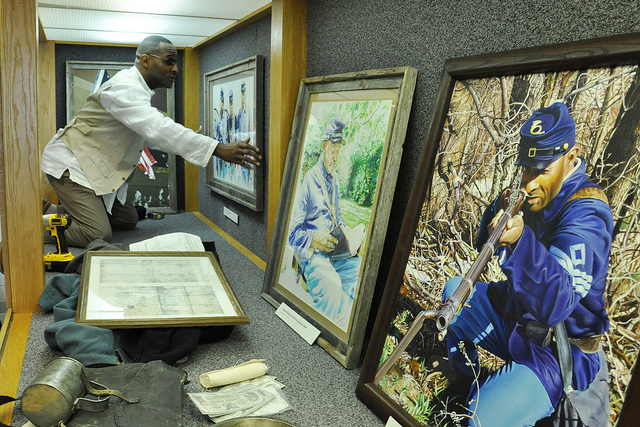
The artist, Essex Garner and a group of Lincoln University college students kicked off the opening with a visit to the exhibit Tuesday.

"This exhibition is about life lessons, a celebration of Family, military service, the importance of a good education, and a tribute to the men of the 62nd and 65th United States Colored Infantry," said Garner, a Art professor in the Visual and Performing Arts Department at Lincoln University, also a Graduate Student at the University completing his third degree in Art education and a Missouri National Guard retiree.
Garner worked with a select group of volunteers who were photographed in reproduction period uniforms and painted on canvas by him. Two of the subjects who participated, Master Sgt. Leo Lewis and Sgt. Bruce Shockley, are Missouri Army National Guard members who work full-time at ISTS.

"People back then were very selfless," said Shockley. "They had specific goals that they wanted to achieve. So it's amazing to be a part of something that reenacts that."
In appreciation for taking the time to volunteer, Garner gave the two Soldiers a gift.
"Mr. Garner gave us printouts of the paintings," said Shockley. "I gave mine to my father and he has it hanging on his wall."
Garner carefully chose who he used as subjects for his paintings.
"I didn't want to use just anybody for these images," Garner said. "When I started asking people, I made sure I asked people who I had served with or who are currently in the military. This way, the paintings have an honorary connection to the military and they could hold their own weight. But when put together, they can tell a story."

One painting within Garner's display shows an Army chaplain teaching a Soldier how to read.
"This picture is trying to illustrate exactly what the guys would look like," said Garner. "I wanted it to look like a dignified man."
African American Soldiers serving in the Civil War couldn't read. At the time, it was illegal to teach African Americans how to read and write. The military realized having illiterate men among its ranks could be an issue, so white officers started reading classes for their troops.
"A lot of unit commanders came out with unit standing operation procedures that said you have to read at certain levels to reach certain promotions," said Garner.

Later, black enlisted Soldiers of the 62nd and 65th United States Colored Infantries founded Lincoln University. The school would benefit freed African Americans.
The last painting in Garner's display shows two African American Civil War Soldiers on present-day Lincoln University campus.
"I wanted to bring those Soldiers forward 150 years, to the place that they started," said Garner.
The Ike Skelton Training Site is the second stop on a four stop tour for the display. From here, the paintings will be on display at the Gains/Oldham Black Culture Center at the University of Missouri. The final stop will be at Lincoln University.

A student at the showing, Johnell McGee, a senior at the University studying studio art, talked about his observations following the exhibit.
"I think all of the works that I see are breathtaking. It's really motivating me to work harder at my craft and think more about the ties and connections than the art itself," said McGee, a Chicago native. "I like how he didn't just pick anybody; he used recent Soldiers and that kind of ties it into the history of the Soldiers from back then."
Garner's wife, Larna, is writing her second children's book and Garner's paintings will be the featured images for story tale.

Garner spent more than half of his 25 years in the Army as an illustrator, artist, and draftsman. He started out in the Active-duty Army and later joined the Missouri Army National Guard, where he retired in 2003.
The exhibition will run through February 29. The paintings will be on display outside the Fallen Warrior Memorial Auditorium in the main building at Ike Skelton Training Site. Visitation is free and open to the public during regularly scheduled business hours Monday through Friday.


Supporting photos can be downloaded from Flickr: http://www.flickr.com/photos/missouriguard/sets/72157629131658505/
Pre-Test Jaywalking Art for Assessing Student Knowledge of the Arts
To download assessment rubric and the Visual Arts Pretest, click on this text or the text within the title and follow hyperlinks.
Subject: VTS Pre-Test of Arts History and General Acquired Knowledge
Grade Level: 10th through 12th, Adaptable to Higher Grades.
Key Concepts and Goals: This pretest evaluation is for the instructor of a “General Arts” classroom to assess basic knowledge of the arts of each student. This test is also a tool for planning and structuring teaching strategies through the VTS process.
Objectives: After watching the “Jaywalking Art” video at the beginning of this class, a pretest assessment given by the instructor should make available to you the following. The instructor and students will be able to assess in generalized terms the amount visual art information that has not been retained by the students’ from or during their general education or liberal arts educational experience. All of the visual arts data within this video “will” be covered during the course of the semester. Although this video is humorous, the main idea is to illustrate the vast void of information that the first year art student forgets from the time they leave their secondary educational environment. You will see that Mr. Leno is asking members of the public basic general art questions that may seem common knowledge for most, but we find out through watching the video, this is not always true.
VTS Pre-test Goals: Initially, before watching the video have all of your students take the pre-test. The test is in a “word format” provided to you on the left side of the video screen once you access the hyperlink. Then, after watching the video, and after you have given the video time to digest, asks questions of your students that pertain to the video. Try and have your students provide honest feedback of what they thought they knew, or didn’t know concerning questions that related to the video. Collect the pretests and score them accordingly using a standard means assessment rubric. 10-9 questions A. 8-7 questions B, etc. Now you have an average assessment of the average student population within your class in reference to visual arts data they have forgotten since high school. The first year general education art students via the mean (average) score within an age group set to 10 questions, and the standard deviation (SD) to 4. Sometime before the semester’s end or during the midterm, give a similar test or pop quiz of the same comparable information, and you will be able to compare for yourself the results. The video is approximately five minutes and one second in length. Review and grade the answers and find out for yourself the average score of your class.
To score your class results or to see how you hold up after watching this video, please download the pre-test and answer sheet data rubric provided. Not only is it fun, but you may also learn something.
Adaptations (For Students With Learning Disabilities): Assess the level of disability, sit near students who need additional assistance, Provide larger, easily manageable tables or chairs for students who have difficulty with fine motor skills. Use facilitator if available.
Summary Assessment follow ups to pre-testing. Mr. Leno is using a series of lead one questions that is commonly used within the VTS strategies of artistic thinking. How you structure your lead on questions that relate specifically to the images within this Pre-test is the key, and these same images from the video can and usually do run concurrent with most curriculums and teaching strategies. This VTS approach maybe humorous, but it does introduce you and the student to a method of open-ended discussions, which if properly facilitated can allow for a much more diverse opinion and debate (Housen & Yenawine, 2011). Learning to think and communicate through the arts encourages the finding of stories and or activities which is a method of playing into the natural tendencies of the beginning or more advanced viewers (see VTS Research and Theory pp. 14-17). For high school and Freshman level college prep or traditional classes this is just another unique approach to the pre-testing process of linking thought, question awareness, and the development of connections to other classes. This is simply a humorous way at arriving to the same end. The class size for this particular session is twenty-five. This particular pre-test is given out during the first day of class. See summary reporting, end of semester reporting for the means adjusted of questions and images 1 through 10 can be viewed within scoring rubric answer sheet.

Subject: VTS Pre-Test of Arts History and General Acquired Knowledge
Grade Level: 10th through 12th, Adaptable to Higher Grades.
Key Concepts and Goals: This pretest evaluation is for the instructor of a “General Arts” classroom to assess basic knowledge of the arts of each student. This test is also a tool for planning and structuring teaching strategies through the VTS process.
Objectives: After watching the “Jaywalking Art” video at the beginning of this class, a pretest assessment given by the instructor should make available to you the following. The instructor and students will be able to assess in generalized terms the amount visual art information that has not been retained by the students’ from or during their general education or liberal arts educational experience. All of the visual arts data within this video “will” be covered during the course of the semester. Although this video is humorous, the main idea is to illustrate the vast void of information that the first year art student forgets from the time they leave their secondary educational environment. You will see that Mr. Leno is asking members of the public basic general art questions that may seem common knowledge for most, but we find out through watching the video, this is not always true.
VTS Pre-test Goals: Initially, before watching the video have all of your students take the pre-test. The test is in a “word format” provided to you on the left side of the video screen once you access the hyperlink. Then, after watching the video, and after you have given the video time to digest, asks questions of your students that pertain to the video. Try and have your students provide honest feedback of what they thought they knew, or didn’t know concerning questions that related to the video. Collect the pretests and score them accordingly using a standard means assessment rubric. 10-9 questions A. 8-7 questions B, etc. Now you have an average assessment of the average student population within your class in reference to visual arts data they have forgotten since high school. The first year general education art students via the mean (average) score within an age group set to 10 questions, and the standard deviation (SD) to 4. Sometime before the semester’s end or during the midterm, give a similar test or pop quiz of the same comparable information, and you will be able to compare for yourself the results. The video is approximately five minutes and one second in length. Review and grade the answers and find out for yourself the average score of your class.
To score your class results or to see how you hold up after watching this video, please download the pre-test and answer sheet data rubric provided. Not only is it fun, but you may also learn something.
Adaptations (For Students With Learning Disabilities): Assess the level of disability, sit near students who need additional assistance, Provide larger, easily manageable tables or chairs for students who have difficulty with fine motor skills. Use facilitator if available.
Summary Assessment follow ups to pre-testing. Mr. Leno is using a series of lead one questions that is commonly used within the VTS strategies of artistic thinking. How you structure your lead on questions that relate specifically to the images within this Pre-test is the key, and these same images from the video can and usually do run concurrent with most curriculums and teaching strategies. This VTS approach maybe humorous, but it does introduce you and the student to a method of open-ended discussions, which if properly facilitated can allow for a much more diverse opinion and debate (Housen & Yenawine, 2011). Learning to think and communicate through the arts encourages the finding of stories and or activities which is a method of playing into the natural tendencies of the beginning or more advanced viewers (see VTS Research and Theory pp. 14-17). For high school and Freshman level college prep or traditional classes this is just another unique approach to the pre-testing process of linking thought, question awareness, and the development of connections to other classes. This is simply a humorous way at arriving to the same end. The class size for this particular session is twenty-five. This particular pre-test is given out during the first day of class. See summary reporting, end of semester reporting for the means adjusted of questions and images 1 through 10 can be viewed within scoring rubric answer sheet.

Reference:
Yenawine, Philip (2011). VTS Visual Thinking Strategies. Jumpstarting
Visual Literacy: Thoughts on Image Selection. Visual Understanding
in Education. VEU, Brooklyn, NY
Visual Literacy: Thoughts on Image Selection. Visual Understanding
in Education. VEU, Brooklyn, NY
Video the Royal Family (Akhenaten) at Tel-Amarna VTS
This video is 18:28 in length. Use Windows Media Player. Click on text above or this link to play this VTS session.


VTS Assyrian Figure at Lincoln University.wmv
Click on title above to activate video
This VTS was of course different from the initial ones, versus the little groups with my daughters and their guests. My Introduction to Art class at Lincoln University consists of more than twenty students. So the personable connections that I have made with my family are nothing like the ones I make with these classes. Most all of the intro students seemed enthusiastic about this VTS session, and now that we have completed this one, most are looking forward to more, and many of them are almost expecting it. I was afraid that the Assyrian figurine might be provocative for my groups at home, but not with this class because of the age difference. The dilemma of introducing cross-cultural artifacts into the discussion versus the little groups with my daughters also becomes a non-issue. Although I thought it proper to receive an OK from the Fine Arts department at Lincoln University first before producing this video. Dr. Don Govang Chair of the Department of Visual and Performing Arts informed me that as long as the video was for educational purposes, it was fine.
What did the students notice about the art?
Most of the group picked up on the points that this was some type of ceremonial figurine or something in relationship to a religious type of idol. There were a couple questions about the figure’s origin and medium that came up during this discussion. There was a similar connection that my larger class made that my smaller group at home paralleled with, and that was the Egyptian geographical and stylized connections. Although I know we have been covering the Paleolithic through Mesolithic Stone Age periods in my Intro class, it’s partly impossible to cover every minute aspect, but this figurine became an interesting motif. They understood that this figurine had some sort of meaning, either within a religious or ceremonial context. The students interactions during this VTS session was nothing unusual, and I was pleasantly surprised at how many of them kept digging for data, which brings me directly to my next observation.
You can scarcely pick up on or hear this observation during the video, but a number of students complained to their classmates that it was evident that only a few people were taking part in the discussions. They were correct, because this class (besides the three late comers, you can hear the door slamming a view times) consists on a daily average of twenty plus students. Although, during the VTS there were only five or six "active" participants that either had inquiry or was lead into query. Two of my students put their classmates on notice that they need to start asking questions, especially since it appears that we will be doing another one of these in the near future. Even the gentleman who was operating the camera appear interested in doing another video, although we unquestionably need to work on some lighting issues.
My facilitating and practice sessions are improving and I was comfortable with this class because I have been interacting with them now for a few weeks. Getting out of the way and letting the discussion take its natural course is something that I still have to work on, but looking at the video I do see some improvements versus our last session at the museum. Some of the students commented on this, and I believe I reverted to my less didactic demeanor myself. Now there was a learning moment if I have ever had one.
Were there any surprises? Yes, this session went better than I expected, although in retrospect, I’m not really sure what I expected. It appears that these students made the cross connection that art crosses over into our lives not only through paintings and drawings, but it also makes social and religious statements within the instrumentalist method of judging art. Although I was worried about some of the young adults’ vocabularies that I hear my students use. I was hoping that none of that would find its way into the audio section of this or any VTS. That was not a problem, nor do I think it will ever be a problem in the future. One of my students in this class, I had when I was student teaching at Saint Joseph Elementary School over seven years ago. Let’s not forget; unlike the high school arena, the average age of these students’ is eighteen or twenty. Many of them are fresh out of high school with some of their colorful metaphors still in tact; well I think you get the picture, enough said about that.
Subscribe to:
Posts (Atom)